Saturday, 7 December 2013

TELEVISION REVIEW: The Walking Dead 4.8, "Too Far Gone"


It’s a testimony to the emotional intensity of AMC’s The Walking Dead that as I'm writing this, my hands are literally shaking. Often there have been occasions that I've found myself on the edge of my seat, my hands over my mouth or even in the rarest of circumstances, tears forming at the corners of my eyes. Never before however, have I been custom to all of these visible signs of distress, anguish and heartbreak.

“Too Far Gone”, the Season 4, mid-season finale serves as the culmination point of everything that has happened over the past seven episodes. Rick Grimes’ (Andrew Lincoln) ragtag group of weary survivors, having recently recovered from the aftermath of a fatal disease, are finally reunited with The Governor (David Morrissey) and subsequently the members of Woodbury 2.0.

The first half of the mid-season finale gets off to a slow start. In the bowels of the prison, Daryl learns of Carol’s banishment whilst Tyreese still demands justice for Karen’s murder. At Woodbury 2.0, somewhere on the other side of the fence, The Governor is giving a rousing speech attempting to persuade the group into attacking and taking over the prison.

Just as Rick and Daryl are about to inform Tyreese of the truth regarding Karen’s demise, they’re soon interrupted by an explosion from above ground. Once outside, they’re confronted by The Governor, who inconveniently for the prison group, happens to be in possession of a tank. Despite a glistening speech from Rick that offers an alternative to The Governor’s propositions, our hopes and dreams are soon thrown to the ground to be crushed beneath the weight of the Chekhov Tank.

What follows is a plethora of bloodshed, fire fights and multiple character deaths -- one or two that will sit uncomfortably with you for a long time to come. Individual fights break out all over the prison courtyard as we see the various members of the prison group hold their own against the onslaught of The Governor. Daryl (Norman Reedus) is in usual fashion here, single-handedly taking on multiple would-be soldiers in one fell swoop.

However, it’s only when the action begins to let up and we’re finally given some room to breathe, that “Too Far Gone” cements itself as perhaps the single greatest episode of The Walking Dead to ever air. Once again, Lincoln offers an award worthy performance in his portrayal of Rick Grimes. Additionally, multiple character and story dynamics are thrown into disarray as we finally get the finale we deserved at the end of the last season.

Regardless, all is forgiven in light of the events in this week’s episode. Once February rolls back around with the second half of Season 4 in tow, all past discrepancies will be forgotten as we get ready to submit ourselves to another eight weeks of emotional trauma.

I hope to see you there.


5/5

Monday, 4 November 2013

FILM REVIEW: Ruby Sparks (2012)

File:Ruby Sparks poster.jpg

In Ruby Sparks, leading character Calvin Weir-Fields (Paul Dano) is a young novelist, struggling to recreate the success of his first novel. After being given a writing task by his therapist, Calvin sets out to create a character who likes Scotty, his rather uninspiring dog. He dreams up a girl named Ruby Sparks (Zoe Kazan) and inspired at long last, he begins to write about her. However Calvin soon falls in love with his creation, which is only made more problematic when Ruby comes to life.

Directed by Jonathan Dayton and Valerie Faris (Little Miss Sunshine), Ruby Sparks is a comedic indie flick, telling the story of a struggling relationship between a novelist and his creation. The central themes of the story are deeply rooted from the start, as we see Calvin living with his loneliness as well as his need to control everything in his life. Ruby’s existence offers him companionship, but his reliance on her is ironically the cause of the pair’s ensuing issues.

Dano and Kazan are superb as Calvin and Ruby and their on screen chemistry is charming and believable (which is only helped by the pair’s real life relationship). Ruby Sparks also features appearances from Calvin’s friend and fellow author, Langdon Tharp (Steve Coogan), as well as Mort (Antonio Banderas) as the boyfriend to Calvin’s mother. Calvin’s brother, Harry (Chris Messina), serves as the catalyst for many of the film’s more light-hearted moments, injecting a shot of comedy in whatever scene he appears in.

The script (which was written by Kazan) manages to maintain the right direction throughout the film’s entirety. The pacing is also well executed as we are catapulted from scene to scene with drastic changes of emotion. One moment you’ll be laughing with the on-screen couple, and as little as five minutes later you’ll be fraught with worry as you find yourself caught up in the ever increasing conflicts between Calvin and what appears to be just about everyone else.

Ruby Sparks is very comfortable with what it is: an off-beat romantic comedy, tinged with intelligent commentary that looks at everything from the modern mind; the struggles of being alone, as well as the concept of bringing others down to nothing more than an idea of how we see them. Asides from its supernatural elements, Ruby Sparks is very much grounded in reality and submerged in its 21st century issues.

Despite all of this, Ruby Sparks still makes time for a fun and watchable experience. While the ideas it presents are seemingly straight forwards, the film opens itself up to much debate once the credits begin to roll. Ruby Sparks is an exceptional film, one that many indie flicks should aspire to be as good as.

4/5 

Thursday, 31 October 2013

THEATRE REVIEW: The Beauty Queen of Leenane (@Curve, Leicester)


The show opens with a downpour of rain, drenching the front of the stage and splattering any viewer unfortunate enough to be sat in the front row. It’s an interesting touch and a well done one at that.

But if metaphors were ever apparent (in whatever way you may view a downpour of rain), this would be one that would carry itself throughout the entirety of Martin McDonagh’s The Beauty Queen of Leenane.

Immediately afterwards we are introduced to two of the play’s four central characters – the old and somewhat senile Mags (played by the wonderful Nora Connolly), and her daughter, the love-starved (and sex-starved, if you will) Maureen (Michele Moran).

Before even a line of dialogue passes between the two, we are aware of the rising tension in the room. It is quite obvious to the audience that the relationship that these two women share isn’t quite what you would expect from the regular mother-daughter combo. The show’s two hours keeps us entertained with the constant banter and bickering between the two.

The majority of the play takes place in the living area in the house that Maureen and her mother share. While tightly knit, the stage design doesn't do much to amplify any of the conflicts between the characters. This was disappointing to say the least, as this was a feature that could have been well used to compliment the claustrophobia that Maureen must deal with as a result of her mother’s over-bearing presence.

The Dooley brothers, Ray (Andrew Macklin) and Pato (Stephen Hogan) add a welcome dose of comedy and drama (respectively) outside of the mother-daughter pairing. Ray offers laughs-a-plenty in his seemingly aggravated nature and is easily the star of the show (that is, if you can manage his accent bordering on the tinges of being Welsh).

However, and with the exception of Ray’s scenes, I found myself not nearly enjoying the comedy as much as I thought I would. As a fan of McDonagh’s works in film (particularly In Bruges and Seven Psychopaths) I did go into this expecting it to a bit of belly-slapper.

But where a great deal of the audience was laughing at the interaction between Mags and Maureen, I often found myself forcing a smile. Every moment had the potential to be as hilarious as the scenes involving Ray, but I couldn’t help but feel as if they fell a bit flat more often than not.

Outside of the comedy it is the story and the constant momentum that it breeds that carries the play through to its unpredictable and satisfying end. Scene after scene further raises the tensions and conflicts and I found myself sitting on the edge of my seat during the climatic final moments.

Verdict: whilst entertaining and extremely well acted, it leaves behind a lot of potential to be much funnier than it actually is.


Rating: 3/5

Wednesday, 30 October 2013

ALBUM REVIEW: Protest The Hero - Volition (2013)

File:Volition artwork.jpg

Protest The Hero are a group that have garnered much wide-spread attention thanks to their intense guitar riffs, pounding drums, bouncing bass lines and of course, vocalist Rody Walker’s incredible diversity. Kezia was a brilliant debut, whilst sophomore effort Fortress was (and still is) a mind-blowing experience.

But for those of you who felt that their last outing, Scurrilous, didn't quite live up to the highs that they had previously set themselves, you need not worry. Volition is every bit as brilliant as a PTH record should be, and then some.

For the most part, Volition comes across as combining the finer moments from PTH’s back-catalogue, fusing together riffs, melodies and grooves together in a way that the band had previously attempted, but never quite managed. Even with the departure of drummer and founding member Moe Carlson and the band resorting to crowd-funding to get the album of the ground, Volition is without a doubt the keystone in PTH’s career to date.

The album opens with ‘Clarity’, its infectious beats and grooving guitars managing to effortlessly lure you in for the next fifty-four minutes. ‘Drumhead Trial’ and ‘Tilting Against Windmills’ follow up, but it’s not until ‘Without Prejudice’, with its thundering bass line and melodic chorus that you really get a sense that PTH are pulling out all the stops with their recent release.

And sure enough, the rest of the record quickly follows suit. ‘Yellow Teeth’ is a powerhouse of a track that leads into the second half of Volition with a juggernaut of momentum that is just impossible to stop.

Of course though, just when you think PTH do not feel the need to give themselves any breathing space, the final moments of ‘Plato’s Tripartite’ comes as a pleasant surprise. Its soothing acoustics and intertwining vocals from front-man Rody and guest vocalist Jadea Kelly creates a sound that is unlike anything PTH have done to date.

One listen to tracks ‘Mist’ and ‘Skies’ is enough to tell the listener that PTH are not a band who are afraid of venturing outside of their comfort zone. But while PTH might be stepping out into the direction of a sound that might alienate any long-time fan, they instantaneously make it theirs to show off.

Finale ‘Skies’ is arguably the highlight of Volition and one of the best tracks the band have written to date. Along with ‘Tilting Against Windmills’ and ‘A Life Embossed’ it sees the return of Rody’s screamed vocals. For those of you missed them on Scurrilous, rejoice!

As a whole, Volition is the best PTH record to date, never once faltering or ever falling flat. It gives fans of old a little bit of something that they had managed to encapsulate on previous releases whilst still leaving itself open for new fans to jump aboard. For anybody who is a fan of well-written riffs and beats, give Volition a listen. It’s easily one of the finest records to be released in recent memory.


4/5

Thursday, 14 March 2013

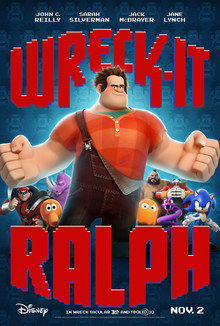
REVIEW: Wreck-It Ralph (2013 [UK])

File:Wreckitralphposter.jpeg

(US poster)


Wreck-It Ralph is the perfect homage to 90s videogames. Because of this, you would be forgiven for thinking that this film might not be your cup of tea. But don’t let that put you off. At its heart Wreck-It Ralph is very much a typical Disney film and it has everything you would expect from the finest animators in movie history: emotionally invested characters, an original and deep plot-line, top of the line voice acting and the capacity to make a grown man cry.

The leading character, Ralph (voiced by John C. Reilly) is the ‘villain’ in the popular videogame Fix-it Felix Jr. He’s been doing his job for many years, wrecking the same building over and over again. Ralph doesn’t have an issue with this. What he does have an issue with however, is not being respected for what he does. On the basis of this, he decides to go ‘turbo’ and he leaves his game to acquire a medal from the world of Hero’s Duty. However, things soon turn sour, as Ralph is held responsible for the future fate of his game and the arcade where he calls home.

Joining John C. Reilly is a star-studded cast, featuring the talents of Sarah Silverman, Jack McBrayer, Jane Lynch and Alan Tudyk. As you’d come to expect from Disney, the voice acting never falls flat and does well to supplement the already brilliant script. Silverman is a highlight as the squeaky voiced youngster Vanellope von Schweetz, who ends up befriending Ralph.

Wreck-It Ralph holds many videogames references, but not so many that it gets to the point where it alienates the audience. Featuring characters and references to popular franchises such as Mario, Sonic and the Metal Gear Solid series, Wreck-It Ralph is a video game fan’s wet dream.

Ralph is also one of the finest Disney characters ever created. His penchant and desire to become more appreciated for what he does makes him a character that most people will relate to. His initial desire develops well over the course of the film as he comes to realise that his friend’s dreams are equally as important as his own. More often than I’d like to admit I had to fight back tears, particularly during the final moments.

Verdict: a tight script, brilliant casting and an emotional plot do well in making Wreck-It Ralph one of the greatest Disney films of all time, if not the best.

Score: 9.5/10