Thursday, 17 January 2013

REVIEW: Lawless (2012)

File:Lawless film poster.jpg


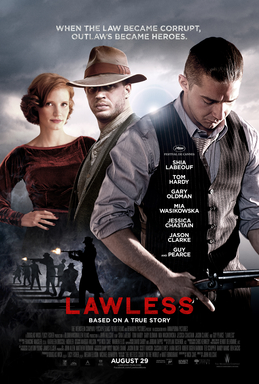
Lawless tells the true story of the Bondurant brothers against the backdrop of prohibition era America. The three brothers, Jake (Shia Labeouf), Forrest (Tom Hardy) and Howard (Jason Clarke) go out to seek their piece of the American Dream by running a bootlegging operation. However, things get awry when the law turns up to stop their goals.

For the most part, the cast is a brilliant ensemble. LaBeouf stands out as the youngest brother and lead protagonist amongst his on screen siblings. While hard to like as the stern and often cold Forrest, Hardy plays his role well and while fluctuating between being likeable or not, he’ll hold a soft spot in your heart by the time the credits roll. Guy Pearce is the star of the show here as the sadistic law enforcer Charley Rakes. Other noticeable performances come from Mia Wasikowska and Jessica Chastain as the love interest for LaBeouf and Hardy respectively. As mobster Floyd Banner, Gary Oldman has no more than five minutes of screen time in one of most disappointingly underplayed roles in 2012.

Despite being accompanied by a well written script, the pacing is odd throughout the length of the feature. The first half does well to set up the story and establish who the characters are but does little in the way of anything exciting. This wouldn’t be quite so uncomfortable if the second half wasn’t the polar opposite of what has proceeded. A sequence of action scenes unfold in the final 45 minutes which contrasts against the drama that has come to be expected. When the action does play out it seems to be over before it ever really starts. When the final moments could have been longer and more exciting, it seems director John Hillcoat has missed out on an opportunity to create something more memorable.

Regardless, the final scenes are still well acted and the high mounting drama that has held strong throughout concludes effectively in the films closing moments. Screen writer and soundtrack scorer Nick Cave does a brilliant job of capturing a sense of early 20th century America while also combining a more punkish element to accompany the score.

Verdict: although well acted and well scripted, the action and odd pacing leaves something to be desired.

Score: 7.0/10

Saturday, 12 January 2013

REVIEW: The Descendents (2011)

File:Descendants film poster.jpg


The Descendents opens with a monologue from central character Matt King (George Clooney) after a boating accident leaves his estranged wife Elizabeth (Patricia Hastie) comatose. In his monologue, Matt explains that he is the “other parent” to two daughters, 17 year old Alexandra King (Shailene Woodley) and 10 year old Scottie King (Amara Miller). After Matt finds out that his wife was having an affair, the plot follows him and his two daughters as they go looking for the only man that Elizabeth had possibly ever loved. Matt must come to terms with his wife’s betrayal after he finds out that she will never recover from her coma.

At its center, The Descendents deals with the heartbreak and traumas that everyday families go through on a daily basis. It showcases the unpredictable mess that is life in a comedy-drama that somehow manages to portray a positive outlook on life while simultaneously leaving a hollow pit inside of you.

Clooney plays one of the greatest roles of his career to date as the beaten and tired trustee of his families land. Woodley and Miller are excellent as Clooney’s on screen daughters, particularly the latter as Scottie’s desperate need for attention and alienating nature provide more than enough comedic moments.

Both the literal journey the characters go on and the metaphorical one that Matt must take propel this film onwards at a well executed pace. Matt’s occasional voiceovers fit perfectly as he reflects on the changes he goes through over the course of the film’s two hours.

Additionally, Matt has to make the decision of what to do with the land that he and his cousins have inherited between them. Matt is originally willing to sell the 25,000 acre land, but his choices regarding this matter become complicated when the two plots eventually merge together.

The ending is somewhat predictable and although the story is intriguing, it seems sparse as the running time does little to advance the plot in several scenarios. Regardless, stellar performances keep this film afloat and when the conclusion does eventually roll around, it’ll bring with it a strange sense of satisfaction, even if you do figure out how it’ll finish before the credits roll.

Verdict: although there are a few moments where little happens, The Descendents is highly enjoyable and a treat to watch.

Score: 8.0/10

REVIEW: Moneyball (2011)


File:Moneyball Poster.jpg

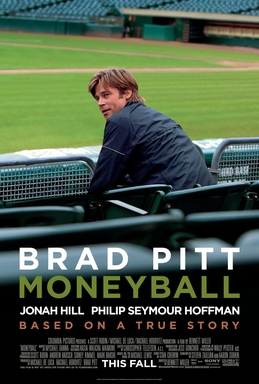
Based on true events, Moneyball tells the story of Billy Beane (Brad Pitt), the general manager of the Oakland A’s in his quest to reinvent the conventions of baseball. After his team loses in the 2001 postseason and the departure of the A’s three star players, Beane is forced to create a new team on a limited payroll. Going against the better wishes of his scouts, he enlists the help of Yale economics graduate Peter Brand (Jonah Hill) to help build a team based on their base percentage rather than their characteristics.

The performance between Pitt as a no-nonsense and upfront general manager and Hill as his intelligent but hesitant assistant is wonderful and it leaves you questioning why they haven’t been put together before now. Philip Seymour Hoffman also stars, although he is massively underplayed in his role as the A’s manager. Pitt is the star of the show here as he masterfully portrays the struggles Beane goes through in order to reinvent the future of baseball on a small budget.

Although there is a touching subplot between Beane and his daughter Casey, it feels underappreciated and to an extent tacked on, as the rising triumph of Beane’s team go from strength to strength hogging the limelight of this films plot.

As a sports film, you’d be forgiven for not being interested by the subject, especially if you’re not a fan of baseball. However, this should not matter. Although I knew nothing about baseball before I had watched Moneyball, the film does an excellent job of shifting the focus from the game to what goes on behind the scenes, particularly the people and the problems of matters that most viewers can relate to.

The film does however seem to move at a slow pace, one that conflicts with its nature for what it is: a sports film. The films strengths do derive from its moments that feature Beane and Brand at odds with everyone else but with few sporadic scenes that feature any actual baseball, you’ll be left needing a bit more action by the time the credits roll.

Verdict: a well acted, well scripted look behind the scenes of the sport and the reimagining of old conventions. Moneyball will leave wanting more despite its somewhat slow pacing.

Score: 8.0/10

REVIEW: The Hobbit: An Unexpected Journey (2012)


Both the books and films to the LotR trilogy are considered to be one of the greatest pieces of fantasy fiction in the world over. The prequel to this body of work is The Hobbit, originally a singular novel of a much smaller scale than the sequels. It’s because of this that it is easy to be sceptical of a big screen adaptation that spans nearly three hours and is only the first part of a new trilogy covering the novel in its entirety. But for what it’s worth, there is no cause for alarm as The Hobbit is a masterpiece.

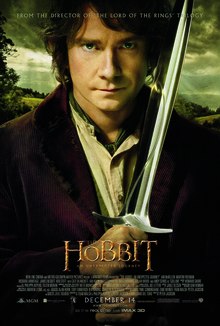
Set 60 years prior to the events that partake in the Rings trilogy, a young Bilbo Baggins (Martin Freeman) along with a company of dwarves go on an adventure to recover a kingdom from the dragon Smaug. While the story isn’t as captivating and as epic as the one that takes place in its successor, it is the events that happen that make this adventure worthwhile.

After a hazy start that arguably takes too long to get going and could have been shorter, Bilbo’s tale goes from strength to strength as the viewer is catapulted from set piece to set piece. Bilbo and his merry company of dwarves, led by Thorin Oakenshield (Richard Armitage) have to outwit man-eating trolls, outrun goblins mounted on their dog-like beasts and come face to face with Smeagol.

Freeman as Bilbo is a pleasure to watch on screen: his hesitation and wit helps to contrast against the 'act now, think later' approach of the dwarves and more often than not his conflicts (particularly early on) with the company will raise a few laughs. Sir Ian McKellen returns as Gandalf (a Grey wizard still) with a performance that lives up to the first trilogy.

However, the amount of characters, especially those in the company can be seen as slightly overwhelming. Of the thirteen dwarves, you will only remember the names of three or four – the ones who are worth remembering. Most of the time the other company members seem to have little or no importance in the first part of this trilogy.

Once the few problems at hand can be looked past, you’ll be in for the greatest fantasy epic that 2012 has to offer – an epic better than the sequels that came before.

Verdict: a fantasy masterpiece with a lot of scale, although it takes too long to get started.

Score: 9.0/10

Sunday, 9 December 2012

REVIEW: Looper (2012)

File:Looper poster.jpg

Described as this year's ‘The Matrix’, Looper is a sci-fi epic about time-travel, gangsters and some awfully messy paradoxes. A monologue from Joe (Joseph Gordon-Levitt) opens the film explaining how time-travel has yet to be invented, but thirty years from now, it exists. However, time-travel is illegal and is used by gangsters who wish to have their ‘hits’ disposed off.
So enters Joe, a hitman who leads a fairly simple life: wait for the hit to appear, take care of the hit, receive payment for the hit and so forth. Life is easy. That is, until his future self (Bruce Willis) is sent back to “close the loop”. And so the films events are set into motion.
Looper has an all-star cast which fit the bill brilliantly. JGL delivers on his leading role particularly as a younger version of Willis, although he is criminally underused in the second half of the picture. Willis is as good as ever, and he makes it easy to sympathise with his the older Joe. Emily Blunt plays a major role in the title and while she doesn’t stand out amongst her male counterparts, her performance is strong and believable as a desperate mother who unconditionally loves her troubled son.
Although sparse, the action scenes are extremely tense and will keep you on the edge of your seat. One particular scene at a diner sees the predictable young Joe up against the more experienced old Joe. Some might say that a few of the scenes are a little too cold-blooded (an escapee hit whose limbs disappear right before his eyes is quite disturbing) but due to the low frequency of such scenes, it never feels like it’s overdone.
There are, however, some major concerns with the plot. Time-travel is a subject that has to be handled carefully, otherwise it’ll leave itself right open to many plot-holes and paradoxes. Looper doesn’t handle it as well as it should do, and unless you’re willing to look past these issues then you shouldn’t have a problem with this.
However if you’re like me, then it could be an issue. I won’t spoil the ending for you, but it left me scratching my head. I understood the plot, but I was left wondering about the ‘ifs’ and ‘maybes’ that should have happened. The plot is pushed along at a nice enough pace that you may forget the inconsistencies, but once the picture has finished, your thoughts will end up coming back to them.

Verdict: overall, a well-acted and thought-provoking film. Some major inconsistencies that will leave you questioning the film long after the credits roll.

Score: 8.0/10